What are dental veneers?
Direct answer
Dental veneers are thin restorations that cover the tooth and make it possible to change the colour, the shape and the proportions, or to disguise small irregularities in the position of the teeth. They can be made in ceramic or in composite resin. Ceramic veneers are made to measure, in a dental laboratory, and bonded to the tooth through physico-chemical processes, following specific bonding protocols.
What dental veneers are for
Treatment with dental veneers is indicated to restore strength to the tooth in situations of fracture or wear, to correct differences in shape and to close spaces between the teeth.
It also makes it possible to correct the colour when tooth whitening is not enough: there are tooth structures that do not respond to whitening in a way that achieves the intended colour.
In some cases they can also disguise misalignment. In those situations, however, orthodontics must always be considered: it is the discipline that corrects tooth position and the spaces between the teeth. Veneers are a quicker means of achieving that alignment, but without any actual tooth movement into the correct position.
The indication begins with the assessment of oral health. It is necessary to ensure that the whole tooth structure is healthy, with no decay and no active periodontal disease. A tooth with decay is not excluded from the treatment, but the decay has to be treated first. It is once the tooth structure is healthy that treatment with veneers restores its strength and allows it to achieve a natural, uniform shape and colour.
Veneers are also indicated in the re-establishment of the bite. In situations of severe tooth wear, use is made of veneers, inlays or overlays to restore the vertical dimension of occlusion — the height at which the arches relate to each other when the teeth come into contact — and to establish a stable bite.
Do the teeth have to be reduced?
Not always. The amount of tooth preparation depends on the position of the tooth, on its shape, on the colour to be disguised and on the space needed for the rehabilitation with the veneer.
On small or retruded teeth, it may be possible to place the veneer without any reduction. In other situations tooth preparation is necessary, to prevent the veneer from adding excessive bulk to the tooth or from compromising the contour next to the gum.
In my practice, before rehabilitation with dental veneers, a diagnostic wax-up is carried out — a smile design that allows us to assess whether or not tooth reduction is needed.
We also make use of magnification with loupes and a microscope to observe and control the details of the preparation, when it is needed, thereby achieving maximum preservation of tooth structure.
The aim, as dentists and restorative clinicians, is to preserve as much tooth structure as possible compatible with the intended result. It is that preservation which underpins the natural look of the result — and which keeps the tooth with as much of its own structure as possible.
Important
Whenever dental veneers are chosen, it is important that prior planning is carried out — the diagnostic occlusal wax-up, commonly known as a wax-up. It allows a precise analysis of the final result before any tooth is touched.
What dental contact lenses are
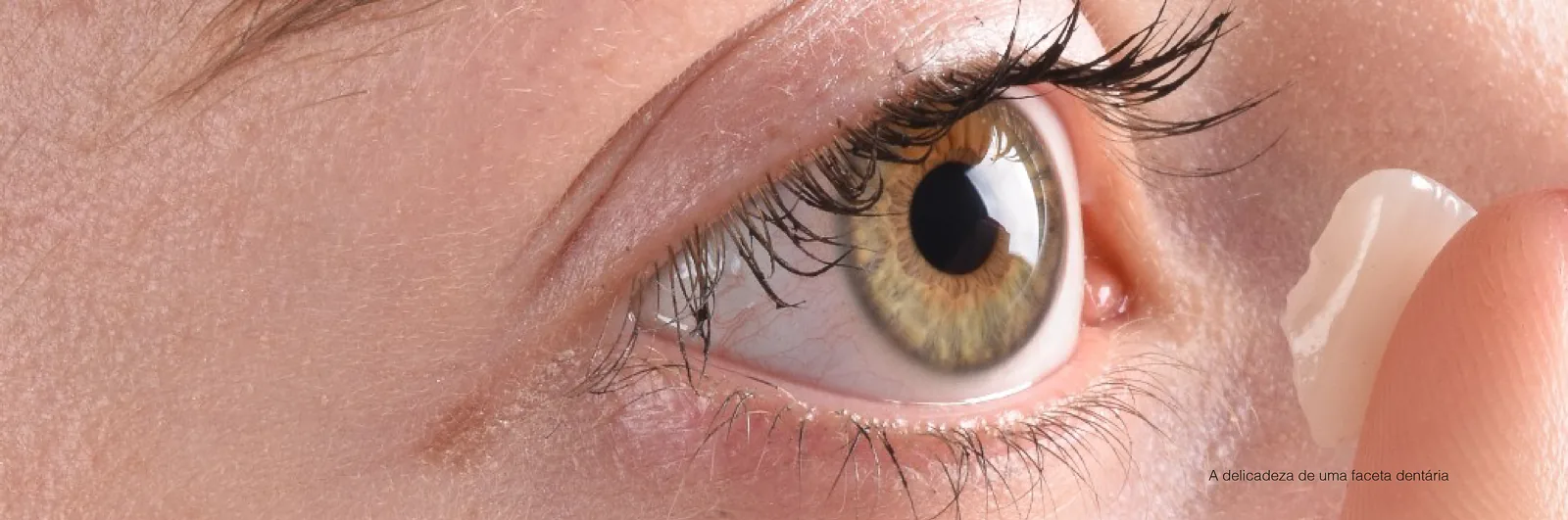
Dental contact lenses is a commercial term used for ceramic veneers that are extremely thin.
This type of veneer is used in situations where there is no tooth reduction, or where it is minimal. The volume required for the veneer is therefore also extremely thin — hence the resemblance to a contact lens.
Why preserving enamel matters
Enamel offers favourable conditions for the bonding of veneers. Preserving it is one of the priorities of tooth preparation.
A systematic review of laboratory studies found higher success rates for veneers bonded to enamel than for those bonded to surfaces with extensive dentin exposure or to previous composite restorations. The findings support the preservation of enamel [3].
Durability nevertheless also depends on the choice of material, on the bonding protocol used, on the bite and on the care taken over time.
How the planning is done
The most important stage of treatment with dental veneers or dental contact lenses is the planning.
We begin with a first consultation, to understand what the patient's expectations are and what they would like to change about their smile. That is what defines all the planning that follows, so that the result the patient expects can be achieved.
We then assess the face, the smile line, the display of the teeth and the gums, the position of the lips at rest and when smiling, and the relationship between the teeth during the bite — in maximum intercuspation and in centric relation.
For this we make use of a facial scanner, an intraoral scanner, intraoral and extraoral photographic records and a recording of the movements of the mandible, in order to develop a design that will be discussed before the appointment at which the veneers are begun.
We carry out a virtual simulation, using software such as Smile Cloud, in which the patient immediately sees the expected result, in photographs or video, before and after.
We also carry out an in-mouth simulation, known as a mock-up, which allows the proposed shape and volume to be assessed and shows what it makes sense to adjust. It is a preview of the treatment — just as an architect designs a house before it is built.
The veneers are made in an in-house laboratory, part of the clinic itself. That control over production allows us to follow the work as it is made, to determine the most suitable materials for each case and to pass on to the laboratory all the clinical information about the shape and the position of the teeth.
How long ceramic veneers last
Treatment with ceramic dental veneers aims to restore function, shape and appearance for a number of years.
Ceramic veneers can remain in function for many years. A systematic review of 25 studies, with 6,500 veneers, estimated a cumulative survival of 95.5% at ten years [2]. A later meta-analysis, with 29 studies, reported survival rates between 93.7% and 96.8% at 10.4 years, depending on the type of ceramic used [1].
Survival does not mean the absence of complications: a veneer may remain in function and still need maintenance or show changes over time. These figures describe the results of the studies and do not constitute a prediction for an individual case.
Can someone with bruxism have veneers?
Yes, a patient with bruxism can have veneers placed. But first it is important to understand what bruxism is.
bruxism is a parafunctional habit that leads to grinding or clenching the teeth, increasing the stress on the teeth and on the restorative materials placed over them.
Note that this stress does not affect all materials in the same way. In treatment with composite resin veneers, for example, the risk of fracture is higher than with ceramic veneers.
That is why planning is decisive. The bite is checked and, when indicated, the increase in the vertical dimension of occlusionis carried out, so as to maintain a correct relationship between the arches, to establish the disclusion guidance and to restore to the teeth an anatomy that ensures function and a sound relationship between the arches.
Together with an occlusal splint made to measure for the bruxism, and with correct use of it by the patient, it is possible to maintain the veneers over the long term. An eight-year prospective study, with 364 veneers in 64 patients, followed 40 people with bruxism: those who wore a splint showed a survival of 89.1% at seven years, against 63,9% in those who did not wear one [4].
The decision depends on the risk in each case, on the planning and on the follow-up.
What care is needed
Once the treatment is finished — with the material chosen to suit the patient and with the bonding protocol appropriate to that ceramic — what is asked of you from then on is simple: daily hygiene, cleaning between the teeth and review appointments.
Where there is an indication for occlusal splint, it is important that it is worn regularly, in line with the dentist's instructions.
Teeth restored with veneers should be used just as we would use our natural teeth. Opening packaging or biting hard objects should be avoided: neither a natural tooth nor a tooth restored with a veneer is meant for that kind of use.
Periodically, there is a need for maintenance appointments, at which the veneers, the gums, the contacts and the bite are checked.
The decision to place veneers starts from a diagnosis and from a comparison of the alternatives. It is important to understand what the patient would like to see improved and to be as minimally invasive as possible, so that the result matches what the patient expects — and gives back a smile they feel good about.
References
- Klein P, Spitznagel FA, Zembic A, Prott LS, Pieralli S, Bongaerts B, Metzendorf MI, Langner R, Gierthmuehlen PC. Survival and complication rates of feldspathic, leucite-reinforced, lithium disilicate and zirconia ceramic laminate veneers: a systematic review and meta-analysis. J Esthet Restor Dent. 2025;37(3):601–619. doi:10.1111/jerd.13351 · PMID 39523553
- Alenezi A, Alsweed M, Alsidrani S, Chrcanovic BR. Long-term survival and complication rates of porcelain laminate veneers in clinical studies: a systematic review. J Clin Med. 2021;10(5):1074. doi:10.3390/jcm10051074 · PMID 33807504
- Alqutaibi AY, Algabri RS, Alghauli MA, Farghal AE, Alnazzawi AA, Saker SES. Survival rate, bond, and fracture strength of laminate veneers bonded to different tooth substrates: a systematic review of in vitro studies. J Prosthodont. 2025;34(6):563–573. doi:10.1111/jopr.13931 · PMID 39207840
- Faus-Matoses V, Ruiz-Bell E, Faus-Matoses I, Özcan M, Sauro S, Faus-Llácer VJ. An 8-year prospective clinical investigation on the survival rate of feldspathic veneers: influence of occlusal splint in patients with bruxism. J Dent. 2020;99:103352. doi:10.1016/j.jdent.2020.103352 · PMID 32413382
References retrieved via PubMed.
Would you like to know whether you are a candidate for veneers?
The assessment begins with a study of the smile and with checking that there is nothing unresolved underneath.
Book a consultation